Istio Service Mesh
auf einem Blatt.
Dichte Referenz für Senior Platform Engineers und SREs. Traffic-Management, Security, Observability, Performance, Multi-Cluster und die häufigsten Fehlerbilder beim Betrieb. Keine Einsteiger-Folien.
Vorschau (3 Seiten A4 quer)


PDF herunterladen
Direkter Download, keine Mail-Adresse nötig. CC BY-SA 4.0 — kopieren, drucken, weiterverteilen ist ausdrücklich erlaubt, solange die Quellenangabe sichtbar bleibt.
Was drin steht
Traffic
Gateway, VirtualService, DestinationRule, ServiceEntry, Sidecar-Scoping — mit Outlier Detection und Connection-Pool-Defaults.
Security
PeerAuthentication, AuthorizationPolicy mit JWT-Claims, RequestAuthentication, SPIFFE-Identity, Migrations-Pattern für mTLS STRICT.
Observability
Telemetry-API, Pflicht-Metriken aus dem Envoy-Stack, Tracing-Header-Propagation, OTel-Logging mit Filter.
Performance
Sidecar-Sizing-Faustregeln, Pilot-Tuning für Push-Storms, Ambient-Mode (1.30 GA) als sidecar-less Option.
Multi-Cluster
Primary-Remote, Multi-Primary, External Control-Plane. Trust-Domain-Setup und Endpoint-Discovery in einem Block.
Diagnose
istioctl-Werkzeuge in Reihenfolge des Vorfalls. Typische 503-UC/NR/UF-Codes mit Ursache.
Cheatsheet im Volltext
Derselbe Inhalt wie im PDF — zum Mitlesen, Durchsuchen und direkten Kopieren der YAML-Snippets. Stand: Istio 1.30 (v1.30 · 2026.07).
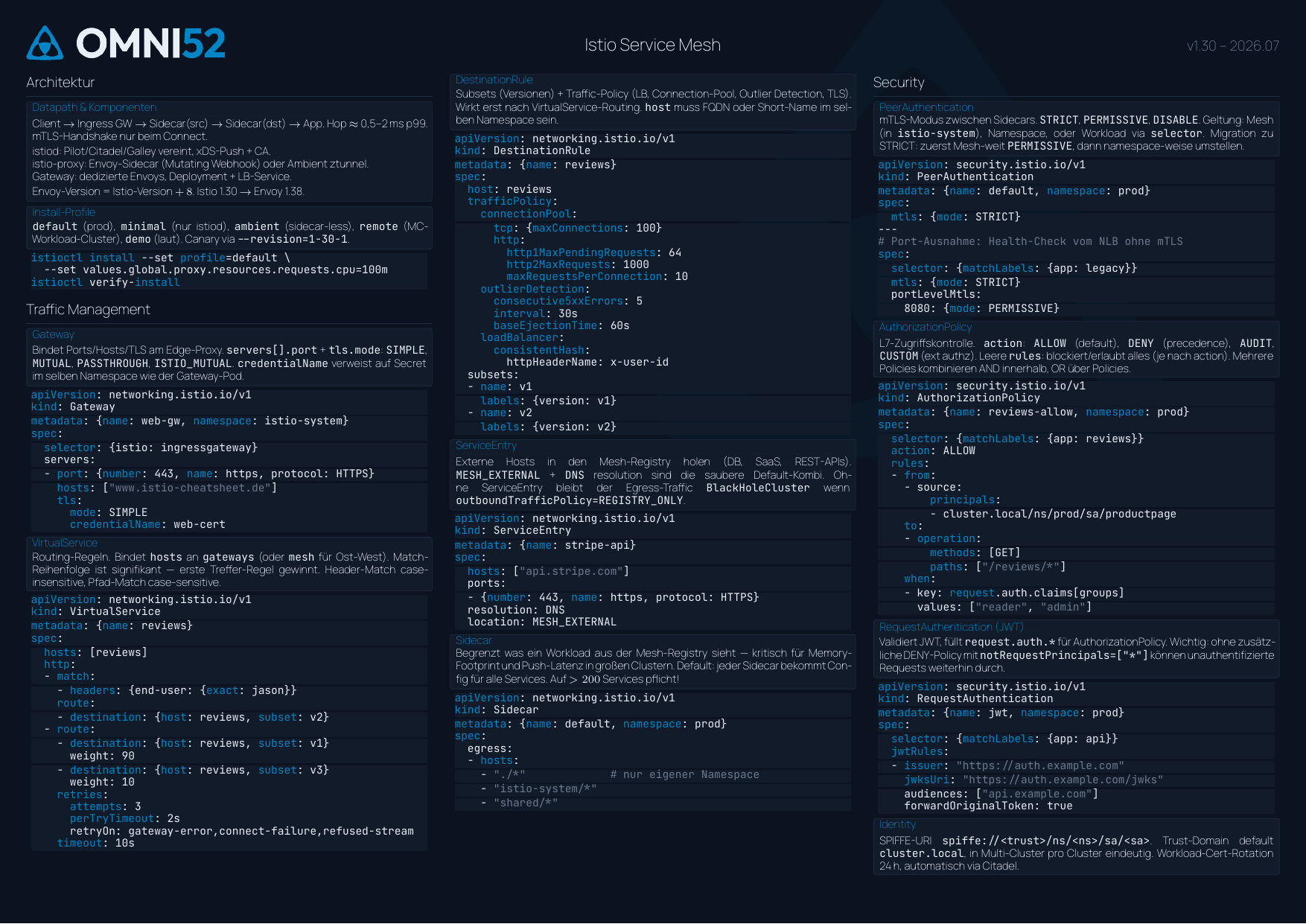
Architektur
Datapath & Komponenten
Client → Ingress GW → Sidecar(src) → Sidecar(dst) → App. Hop ≈ 0,5–2 ms p99. mTLS-Handshake nur beim Connect.
istiod: Pilot/Citadel/Galley vereint, xDS-Push + CA. istio-proxy: Envoy-Sidecar (Mutating Webhook) oder Ambient ztunnel. Gateway: dedizierte Envoys, Deployment + LB-Service.
Envoy-Version = Istio-Version + 8. Istio 1.30 → Envoy 1.38.
Install-Profile
default (prod), minimal (nur istiod),
ambient (sidecar-less), remote
(MC-Workload-Cluster), demo (laut). Canary via
--revision=1-30-1.
istioctl install --set profile=default \ --set values.global.proxy.resources.requests.cpu=100m istioctl verify-install
Traffic Management
Gateway
Bindet Ports/Hosts/TLS am Edge-Proxy. servers[].port
+ tls.mode: SIMPLE, MUTUAL,
PASSTHROUGH, ISTIO_MUTUAL.
credentialName verweist auf Secret im selben Namespace
wie der Gateway-Pod.
apiVersion: networking.istio.io/v1
kind: Gateway
metadata: {name: web-gw, namespace: istio-system}
spec:
selector: {istio: ingressgateway}
servers:
- port: {number: 443, name: https, protocol: HTTPS}
hosts: ["www.istio-cheatsheet.de"]
tls:
mode: SIMPLE
credentialName: web-cert
VirtualService
Routing-Regeln. Bindet hosts an gateways
(oder mesh für Ost-West). Match-Reihenfolge ist
signifikant — erste Treffer-Regel gewinnt. Header-Match
case-insensitive, Pfad-Match case-sensitive.
apiVersion: networking.istio.io/v1
kind: VirtualService
metadata: {name: reviews}
spec:
hosts: [reviews]
http:
- match:
- headers: {end-user: {exact: jason}}
route:
- destination: {host: reviews, subset: v2}
- route:
- destination: {host: reviews, subset: v1}
weight: 90
- destination: {host: reviews, subset: v3}
weight: 10
retries:
attempts: 3
perTryTimeout: 2s
retryOn: gateway-error,connect-failure,refused-stream
timeout: 10s
DestinationRule
Subsets (Versionen) + Traffic-Policy (LB, Connection-Pool,
Outlier Detection, TLS). Wirkt erst nach VirtualService-Routing.
host muss FQDN oder Short-Name im selben Namespace
sein.
apiVersion: networking.istio.io/v1
kind: DestinationRule
metadata: {name: reviews}
spec:
host: reviews
trafficPolicy:
connectionPool:
tcp: {maxConnections: 100}
http:
http1MaxPendingRequests: 64
http2MaxRequests: 1000
maxRequestsPerConnection: 10
outlierDetection:
consecutive5xxErrors: 5
interval: 30s
baseEjectionTime: 60s
loadBalancer:
consistentHash:
httpHeaderName: x-user-id
subsets:
- name: v1
labels: {version: v1}
- name: v2
labels: {version: v2}
ServiceEntry
Externe Hosts in den Mesh-Registry holen (DB, SaaS, REST-APIs).
MESH_EXTERNAL + DNS resolution sind die
saubere Default-Kombi. Ohne ServiceEntry bleibt der Egress-Traffic
BlackHoleCluster wenn
outboundTrafficPolicy=REGISTRY_ONLY.
apiVersion: networking.istio.io/v1
kind: ServiceEntry
metadata: {name: stripe-api}
spec:
hosts: ["api.stripe.com"]
ports:
- {number: 443, name: https, protocol: HTTPS}
resolution: DNS
location: MESH_EXTERNAL
Sidecar
Begrenzt was ein Workload aus der Mesh-Registry sieht — kritisch für Memory-Footprint und Push-Latenz in großen Clustern. Default: jeder Sidecar bekommt Config für alle Services. Auf > 200 Services Pflicht.
apiVersion: networking.istio.io/v1
kind: Sidecar
metadata: {name: default, namespace: prod}
spec:
egress:
- hosts:
- "./*" # nur eigener Namespace
- "istio-system/*"
- "shared/*"
Security
PeerAuthentication
mTLS-Modus zwischen Sidecars. STRICT,
PERMISSIVE, DISABLE. Geltung: Mesh (in
istio-system), Namespace, oder Workload via
selector. Migration zu STRICT: zuerst
Mesh-weit PERMISSIVE, dann namespace-weise umstellen.
apiVersion: security.istio.io/v1
kind: PeerAuthentication
metadata: {name: default, namespace: prod}
spec:
mtls: {mode: STRICT}
---
# Port-Ausnahme: Health-Check vom NLB ohne mTLS
spec:
selector: {matchLabels: {app: legacy}}
mtls: {mode: STRICT}
portLevelMtls:
8080: {mode: PERMISSIVE}
AuthorizationPolicy
L7-Zugriffskontrolle. action: ALLOW
(default), DENY (precedence), AUDIT,
CUSTOM (ext authz). Leere rules:
blockiert/erlaubt alles (je nach action). Mehrere Policies
kombinieren AND innerhalb, OR über Policies.
apiVersion: security.istio.io/v1
kind: AuthorizationPolicy
metadata: {name: reviews-allow, namespace: prod}
spec:
selector: {matchLabels: {app: reviews}}
action: ALLOW
rules:
- from:
- source:
principals:
- cluster.local/ns/prod/sa/productpage
to:
- operation:
methods: [GET]
paths: ["/reviews/*"]
when:
- key: request.auth.claims[groups]
values: ["reader", "admin"]
RequestAuthentication (JWT)
Validiert JWT, füllt request.auth.* für
AuthorizationPolicy. Wichtig: ohne zusätzliche
DENY-Policy mit notRequestPrincipals=["*"] können
unauthentifizierte Requests weiterhin durch.
apiVersion: security.istio.io/v1
kind: RequestAuthentication
metadata: {name: jwt, namespace: prod}
spec:
selector: {matchLabels: {app: api}}
jwtRules:
- issuer: "https://auth.example.com"
jwksUri: "https://auth.example.com/jwks"
audiences: ["api.example.com"]
forwardOriginalToken: true
Identity
SPIFFE-URI spiffe://<trust>/ns/<ns>/sa/<sa>.
Trust-Domain default cluster.local, in Multi-Cluster
pro Cluster eindeutig. Workload-Cert-Rotation 24 h, automatisch
via Citadel.
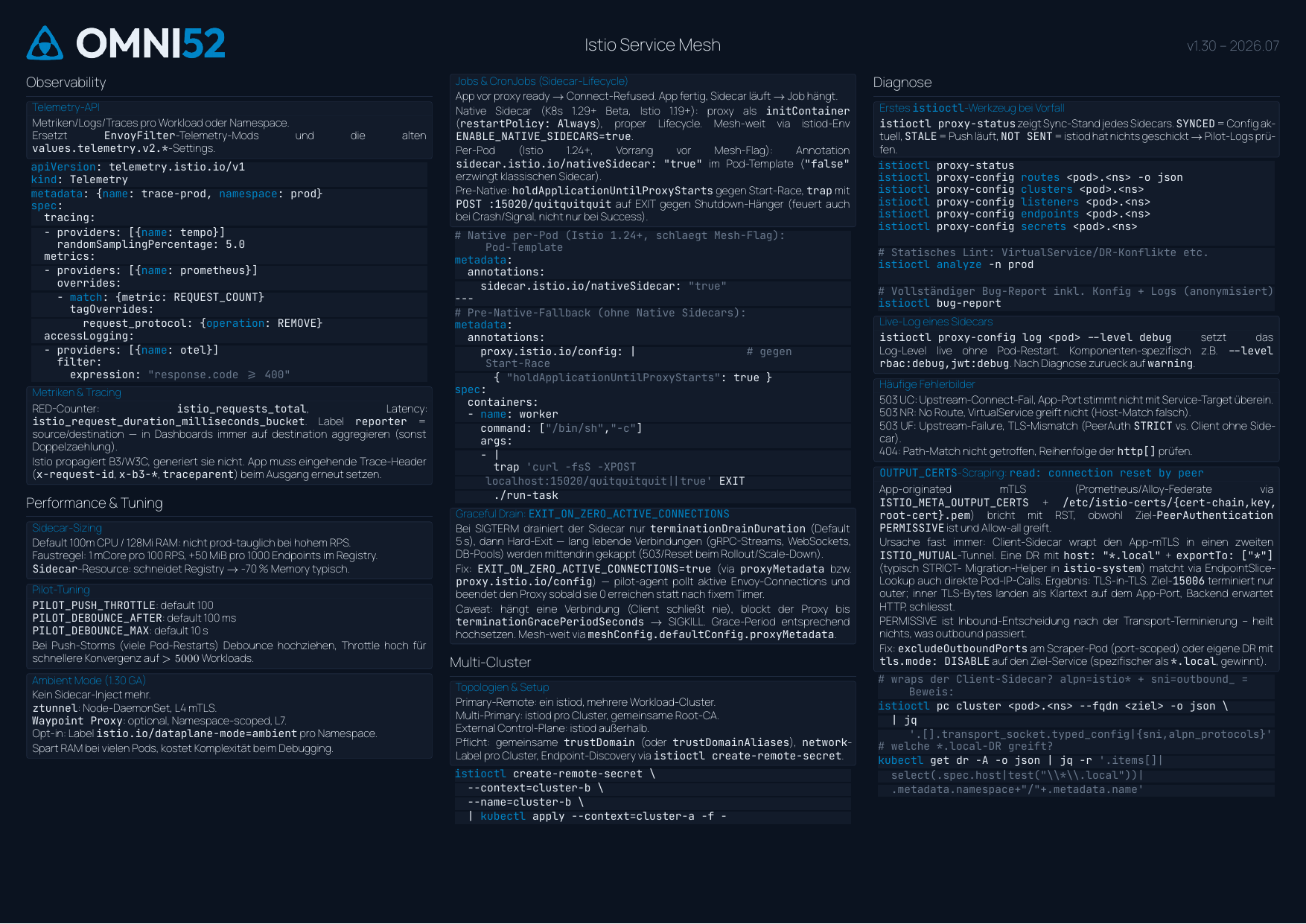
Observability
Telemetry-API
Metriken/Logs/Traces pro Workload oder Namespace. Ersetzt
EnvoyFilter-Telemetry-Mods und die alten
values.telemetry.v2.*-Settings.
apiVersion: telemetry.istio.io/v1
kind: Telemetry
metadata: {name: trace-prod, namespace: prod}
spec:
tracing:
- providers: [{name: tempo}]
randomSamplingPercentage: 5.0
metrics:
- providers: [{name: prometheus}]
overrides:
- match: {metric: REQUEST_COUNT}
tagOverrides:
request_protocol: {operation: REMOVE}
accessLogging:
- providers: [{name: otel}]
filter:
expression: "response.code >= 400"
Metriken & Tracing
RED-Counter: istio_requests_total, Latency:
istio_request_duration_milliseconds_bucket. Label
reporter = source/destination — in Dashboards
immer auf destination aggregieren (sonst
Doppelzählung).
Istio propagiert B3/W3C, generiert sie nicht.
App muss eingehende Trace-Header (x-request-id,
x-b3-*, traceparent) beim Ausgang erneut
setzen.
Performance & Tuning
Sidecar-Sizing
Default 100m CPU / 128Mi RAM: nicht
prod-tauglich bei hohem RPS. Faustregel:
1 mCore pro 100 RPS, +50 MiB pro 1000 Endpoints im
Registry. Sidecar-Resource: schneidet
Registry → -70 % Memory typisch.
Pilot-Tuning
PILOT_PUSH_THROTTLE: default 100.
PILOT_DEBOUNCE_AFTER: default 100 ms.
PILOT_DEBOUNCE_MAX: default 10 s. Bei Push-Storms
(viele Pod-Restarts) Debounce hochziehen, Throttle hoch für
schnellere Konvergenz auf > 5000 Workloads.
Ambient Mode (1.30 GA)
Kein Sidecar-Inject mehr. ztunnel:
Node-DaemonSet, L4 mTLS. Waypoint Proxy:
optional, Namespace-scoped, L7. Opt-in: Label
istio.io/dataplane-mode=ambient pro Namespace. Spart
RAM bei vielen Pods, kostet Komplexität beim Debugging.
Jobs & CronJobs (Sidecar-Lifecycle)
App vor proxy ready → Connect-Refused. App fertig, Sidecar läuft → Job hängt.
Native Sidecar (K8s 1.29+ Beta, Istio 1.19+):
proxy als initContainer (restartPolicy: Always),
proper Lifecycle. Mesh-weit via istiod-Env
ENABLE_NATIVE_SIDECARS=true.
Per-Pod (Istio 1.24+, Vorrang vor Mesh-Flag):
Annotation sidecar.istio.io/nativeSidecar: "true" im
Pod-Template ("false" erzwingt klassischen Sidecar).
Pre-Native:
holdApplicationUntilProxyStarts gegen Start-Race,
trap mit POST :15020/quitquitquit
auf EXIT gegen Shutdown-Hänger (feuert auch
bei Crash/Signal, nicht nur bei Success).
# Native per-Pod (Istio 1.24+, schlaegt Mesh-Flag): Pod-Template
metadata:
annotations:
sidecar.istio.io/nativeSidecar: "true"
---
# Pre-Native-Fallback (ohne Native Sidecars):
metadata:
annotations:
proxy.istio.io/config: | # gegen Start-Race
{ "holdApplicationUntilProxyStarts": true }
spec:
containers:
- name: worker
command: ["/bin/sh","-c"]
args:
- |
trap 'curl -fsS -XPOST localhost:15020/quitquitquit||true' EXIT
./run-task
Graceful Drain: EXIT_ON_ZERO_ACTIVE_CONNECTIONS
Bei SIGTERM drainiert der Sidecar nur
terminationDrainDuration (Default 5 s), dann
Hard-Exit — lang lebende Verbindungen (gRPC-Streams,
WebSockets, DB-Pools) werden mittendrin gekappt (503/Reset beim
Rollout/Scale-Down).
Fix:
EXIT_ON_ZERO_ACTIVE_CONNECTIONS=true (via
proxyMetadata bzw. proxy.istio.io/config)
— pilot-agent pollt aktive Envoy-Connections und beendet den
Proxy sobald sie 0 erreichen statt nach fixem Timer.
Caveat: hängt eine Verbindung (Client
schließt nie), blockt der Proxy bis
terminationGracePeriodSeconds → SIGKILL.
Grace-Period entsprechend hochsetzen. Mesh-weit via
meshConfig.defaultConfig.proxyMetadata.
Multi-Cluster
Topologien & Setup
Primary-Remote: ein istiod, mehrere Workload-Cluster. Multi-Primary: istiod pro Cluster, gemeinsame Root-CA. External Control-Plane: istiod außerhalb.
Pflicht: gemeinsame trustDomain
(oder trustDomainAliases), network-Label
pro Cluster, Endpoint-Discovery via
istioctl create-remote-secret.
istioctl create-remote-secret \ --context=cluster-b \ --name=cluster-b \ | kubectl apply --context=cluster-a -f -
Diagnose
Erstes istioctl-Werkzeug bei Vorfall
istioctl proxy-status zeigt Sync-Stand jedes
Sidecars. SYNCED = Config aktuell, STALE =
Push läuft, NOT SENT = istiod hat nichts geschickt
→ Pilot-Logs prüfen.
istioctl proxy-status istioctl proxy-config routes <pod>.<ns> -o json istioctl proxy-config clusters <pod>.<ns> istioctl proxy-config listeners <pod>.<ns> istioctl proxy-config endpoints <pod>.<ns> istioctl proxy-config secrets <pod>.<ns> # Statisches Lint: VirtualService/DR-Konflikte etc. istioctl analyze -n prod # Vollstaendiger Bug-Report inkl. Konfig + Logs (anonymisiert) istioctl bug-report
Live-Log eines Sidecars
istioctl proxy-config log <pod> --level debug
setzt das Log-Level live ohne Pod-Restart. Komponenten-spezifisch
z.B. --level rbac:debug,jwt:debug. Nach
Diagnose zurück auf warning.
Häufige Fehlerbilder
503 UC: Upstream-Connect-Fail, App-Port stimmt
nicht mit Service-Target überein.
503 NR: No Route, VirtualService greift nicht
(Host-Match falsch).
503 UF: Upstream-Failure, TLS-Mismatch (PeerAuth
STRICT vs. Client ohne Sidecar).
404: Path-Match nicht getroffen, Reihenfolge der
http[] prüfen.
OUTPUT_CERTS-Scraping: read: connection reset by peer
App-originated mTLS (Prometheus/Alloy-Federate via
ISTIO_META_OUTPUT_CERTS +
/etc/istio-certs/{cert-chain,key,root-cert}.pem)
bricht mit RST, obwohl Ziel-PeerAuthentication
PERMISSIVE ist und Allow-all greift.
Ursache fast immer: Client-Sidecar wrapt den
App-mTLS in einen zweiten ISTIO_MUTUAL-Tunnel.
Eine DR mit host: "*.local" +
exportTo: ["*"] (typisch STRICT-Migration-Helper in
istio-system) matcht via EndpointSlice-Lookup auch
direkte Pod-IP-Calls. Ergebnis: TLS-in-TLS. Ziel-15006
terminiert nur outer; inner TLS-Bytes landen als Klartext auf
dem App-Port, Backend erwartet HTTP, schliesst.
PERMISSIVE ist
Inbound-Entscheidung nach der Transport-Terminierung
— heilt nichts, was outbound passiert.
Fix: excludeOutboundPorts am
Scraper-Pod (port-scoped) oder eigene DR mit
tls.mode: DISABLE auf den Ziel-Service (spezifischer
als *.local, gewinnt).
# wraps der Client-Sidecar? alpn=istio* + sni=outbound_ = Beweis:
istioctl pc cluster <pod>.<ns> --fqdn <ziel> -o json \
| jq '.[].transport_socket.typed_config|{sni,alpn_protocols}'
# welche *.local-DR greift?
kubectl get dr -A -o json | jq -r '.items[]|
select(.spec.host|test("\\*\\.local"))|
.metadata.namespace+"/"+.metadata.name'
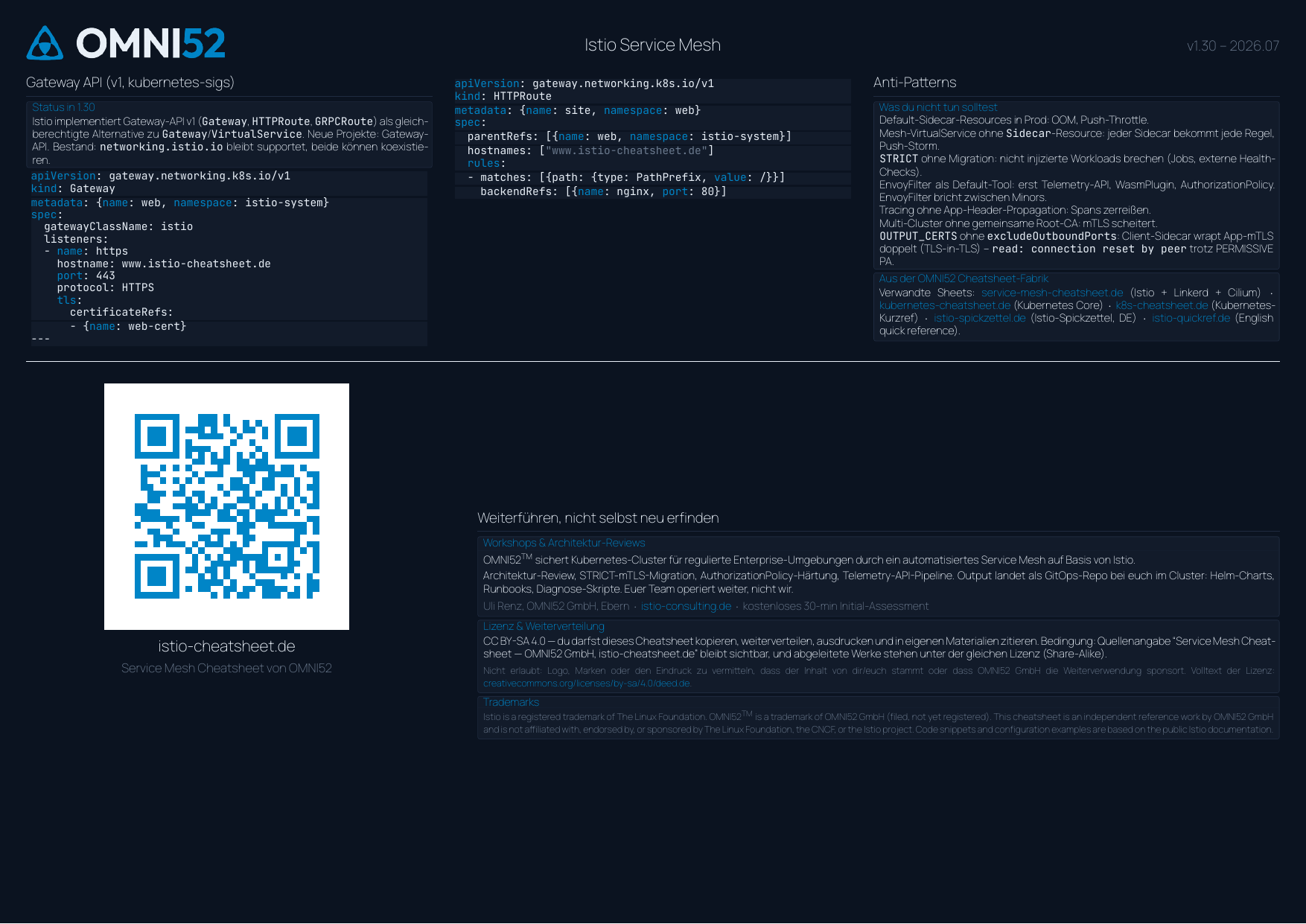
Gateway API (v1, kubernetes-sigs)
Status in 1.30
Istio implementiert Gateway-API v1 (Gateway,
HTTPRoute, GRPCRoute) als
gleichberechtigte Alternative zu
Gateway/VirtualService. Neue Projekte:
Gateway-API. Bestand: networking.istio.io bleibt
supportet, beide können koexistieren.
apiVersion: gateway.networking.k8s.io/v1
kind: Gateway
metadata: {name: web, namespace: istio-system}
spec:
gatewayClassName: istio
listeners:
- name: https
hostname: www.istio-cheatsheet.de
port: 443
protocol: HTTPS
tls:
certificateRefs:
- {name: web-cert}
---
apiVersion: gateway.networking.k8s.io/v1
kind: HTTPRoute
metadata: {name: site, namespace: web}
spec:
parentRefs: [{name: web, namespace: istio-system}]
hostnames: ["www.istio-cheatsheet.de"]
rules:
- matches: [{path: {type: PathPrefix, value: /}}]
backendRefs: [{name: nginx, port: 80}]
Anti-Patterns
Was du nicht tun solltest
Default-Sidecar-Resources in Prod: OOM,
Push-Throttle.
Mesh-VirtualService ohne Sidecar-Resource:
jeder Sidecar bekommt jede Regel, Push-Storm.
STRICT ohne Migration: nicht
injizierte Workloads brechen (Jobs, externe Health-Checks).
EnvoyFilter als Default-Tool: erst Telemetry-API,
WasmPlugin, AuthorizationPolicy. EnvoyFilter bricht zwischen
Minors.
Tracing ohne App-Header-Propagation: Spans
zerreißen.
Multi-Cluster ohne gemeinsame Root-CA: mTLS
scheitert.
OUTPUT_CERTS ohne
excludeOutboundPorts: Client-Sidecar wrapt
App-mTLS doppelt (TLS-in-TLS) — read: connection reset
by peer trotz PERMISSIVE PA.
Aus der OMNI52 Cheatsheet-Fabrik
Verwandte Sheets in dichter Senior-Qualität:
service-mesh-cheatsheet.de — Istio + Linkerd + Cilium im Vergleich
kubernetes-cheatsheet.de — Kubernetes Core
k8s-cheatsheet.de — Kubernetes-Kurzref (gleicher Inhalt, eigene Domain)
istio-spickzettel.de — Istio-Spickzettel (DE)
istio-quickref.de — Istio quick reference (EN)
Lizenz & Weiterverteilung
Nicht erlaubt: Logo, Marken oder den Eindruck zu vermitteln, dass der Inhalt von dir/euch stammt oder dass OMNI52 GmbH die Weiterverwendung sponsort.
Volltext der Lizenz: creativecommons.org/licenses/by-sa/4.0/deed.de.
Istio is a registered trademark of The Linux Foundation. OMNI52™ is a trademark of OMNI52 GmbH (filed, not yet registered). This website is operated by OMNI52 GmbH and is not affiliated with, endorsed by, or sponsored by The Linux Foundation, the CNCF, or the Istio project. “Istio” is used in a descriptive sense to indicate the technology our consulting services focus on.